Churchill & Attlee: The Unlikely Allies Who Won The War by David Cohen
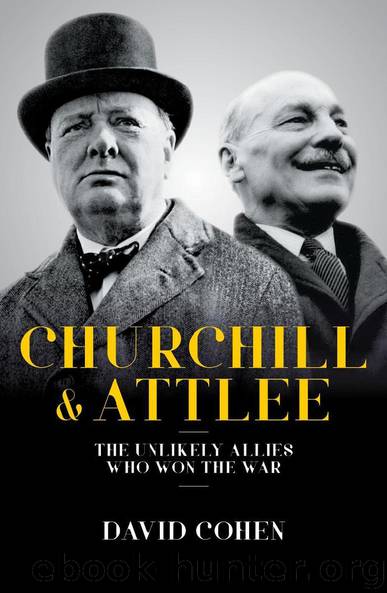
Author:David Cohen [Cohen, David]
Language: eng
Format: epub
ISBN: 9781785903915
Publisher: Biteback Publishing
Published: 2018-06-20T23:00:00+00:00
Attlee wanted the idea to be re-examined. The impact of the proposed Budget on the means test also worried him. This had been introduced so the unemployed could have some help. Some bankers, however, had told him that the means test was a psychological barrier to people saving, as once they had over £375, they did not qualify for any assistance when they became unemployed.
Attlee then returned to the war. He backed Churchill, who had been insisting on the need for more air power since 1932. British forces should have seized an airbase in Norway so the RAF could support the troops, Attlee said. He then contrasted Chamberlain with Churchill, who had ‘great abilities’.
On 2 May, Chamberlain reported on the Norway campaign to the House, but hid behind the need not to reveal much military detail. He admitted, however, that the German Army had been effective, and said British troops had failed to secure the ports of either Narvik or Trondheim. Chamberlain blamed Hitler’s cunning for the military setbacks and went on to describe deceptions that seemed a bit like scenes in an Ealing comedy; many German sailors in Norway had disguised themselves as merchant seamen and had slept in doss houses. Unwisely, Chamberlain also invoked Sir John Moore’s retreat to Corunna in Spain in 1809, claiming it was seen as something of a success in the long run. Chamberlain’s speech ‘was a very obvious flop’, Amery wrote. Attlee felt differently, though, describing the speech as ‘pretty good’. He asked for a full debate to be held the following week, something that Chamberlain had to concede.
This debate would be the prelude to one of the most successful collaborations in British politics.
Psychologists should have studied why they collaborate well when they do, because the discipline has had a long history of feuds where they failed to do so. My first book, Psychologists on Psychology, interviewed thirteen of the world’s great psychologists and examined their often bitter quarrels. Excess ego was a common problem. Sigmund Freud and Carl Jung fell out, for instance, after Freud refused to tell Jung his dreams. Freud did not want his authority challenged by revealing too much of his own inner life.
Sometimes feuds were even more personal. Melitta Schmideberg, the daughter of Melanie Klein, one of the first female psychoanalysts, never forgave her mother for the death of her brother. Klein’s daughter became an analyst herself. She did not speak to her mother for twenty years. She even wore red shoes to celebrate on the day of her funeral. Melanie Klein had many loyal followers but also many enemies. She and Anna Freud feuded for years.
We know, however, a good deal about one successful collaboration between two groundbreaking psychologists. Two years after the Six-Day War between Israel and the surrounding Arab nations of Egypt, Syria and Jordan, Daniel Kahneman invited Amos Tversky to speak at his seminar in Tel Aviv. Tversky had been an Israeli fighter pilot during the war. When he became an academic, he devised experiments that claimed to show people made decisions less rationally than psychology assumed.
Download
This site does not store any files on its server. We only index and link to content provided by other sites. Please contact the content providers to delete copyright contents if any and email us, we'll remove relevant links or contents immediately.
Fanny Burney by Claire Harman(26602)
Empire of the Sikhs by Patwant Singh(23084)
Out of India by Michael Foss(16853)
Leonardo da Vinci by Walter Isaacson(13336)
Small Great Things by Jodi Picoult(7140)
The Six Wives Of Henry VIII (WOMEN IN HISTORY) by Fraser Antonia(5515)
The Wind in My Hair by Masih Alinejad(5095)
A Higher Loyalty: Truth, Lies, and Leadership by James Comey(4962)
The Crown by Robert Lacey(4814)
The Lonely City by Olivia Laing(4801)
Millionaire: The Philanderer, Gambler, and Duelist Who Invented Modern Finance by Janet Gleeson(4478)
The Iron Duke by The Iron Duke(4354)
Papillon (English) by Henri Charrière(4274)
Sticky Fingers by Joe Hagan(4198)
Joan of Arc by Mary Gordon(4109)
Alive: The Story of the Andes Survivors by Piers Paul Read(4031)
Stalin by Stephen Kotkin(3965)
Aleister Crowley: The Biography by Tobias Churton(3640)
Ants Among Elephants by Sujatha Gidla(3467)
